A Clients Muscle Is Stimulated Again Without Time in Between to Relax. What Is This Process Called?
In this folio nosotros look at the physiology behind muscular contraction and what causes a contraction to finish. Low and behold one elementary mineral is really quite critical...
What is the Sliding Filament Theory of muscular contraction?
The sliding filament theory is the explanation for how muscles contract to produce force. As we have mentioned on previous pages, the actin and myosin filaments within the sarcomeres of muscle fibres demark to create cross-bridges and slide past one another, creating a contraction. The sliding filament theory explains how these cross-bridges are formed and the subsequent contraction of muscle.
The Sliding Filament Theory
For a contraction to occur at that place must first be a stimulation of the muscle in the form of an impulse (activeness potential) from a motor neuron (nerve that connects to muscle).
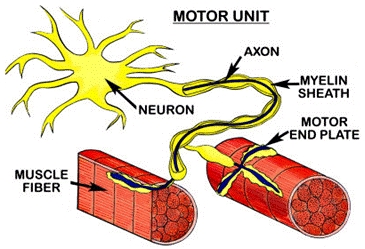
The individual motor neuron plus the muscle fibres it stimulates, is called a motor unit of measurement. The motor end plate (also known as the neuromuscular junction) is the junction of the motor neurons axon and the muscle fibres it stimulates.
When an impulse reaches the muscle fibres of a motor unit, information technology stimulates a reaction in each sarcomere betwixt the actin and myosin filaments. This reaction results in the outset of a contraction and the sliding filament theory.
The reaction, created from the inflow of an impulse stimulates the 'heads' on the myosin filament to attain forward, adhere to the actin filament and pull actin towards the centre of the sarcomere. This procedure occurs simultaneously in all sarcomeres, the terminate process of which is the shortening of all sarcomeres.
Troponin is a complex of three proteins that are integral to muscle wrinkle. Troponin is attached to the protein tropomyosin within the actin filaments, as seen in the image below. When the muscle is relaxed tropomyosin blocks the attachment sites for the myosin cross bridges (heads), thus preventing contraction.
When the muscle is stimulated to contract past the nerve impulse, calcium channels open in the sarcoplasmic reticulum (which is effectively a storage house for calcium within the muscle) and release calcium into the sarcoplasm (fluid within the muscle cell). Some of this calcium attaches to troponin which causes a change in the muscle cell that moves tropomyosin out of the way and then the cross bridges tin can attach and produce muscle contraction.

In summary the sliding filament theory of muscle contraction can be broken downwardly into 4 distinct stages, these are;
1. Musculus activation: The motor nervus stimulates an activeness potential (impulse) to pass downward a neuron to the neuromuscular junction. This stimulates the sarcoplasmic reticulum to release calcium into the muscle prison cell.
2. Muscle contraction: Calcium floods into the muscle jail cell binding with troponin allowing actin and myosin to demark. The actin and myosin cross bridges bind and contract using ATP as energy (ATP is an free energy compound that all cells utilize to fuel their action – this is discussed in greater item in the free energy organisation binder here at ptdirect).
iii. Recharging: ATP is re-synthesised (re-manufactured) allowing actin and myosin to maintain their strong bounden state
4. Relaxation: Relaxation occurs when stimulation of the nervus stops. Calcium is then pumped back into the sarcoplasmic reticulum breaking the link between actin and myosin. Actin and myosin return to their unbound state causing the muscle to relax. Alternatively relaxation (failure) will as well occur when ATP is no longer available.
In order for a skeletal musculus contraction to occur;
1. At that place must exist a neural stimulus
ii. There must be calcium in the muscle cells
iii. ATP must exist available for energy
So, a few things tin stop a contraction;
1. Energy organization fatigue: There is no more than ATP left in the musculus cell so information technology can't keep contracting.
2. Nervous system fatigue: The nervous organisation is not able to create impulses sufficiently or quickly enough to maintain the stimulus and cause calcium to release.
3. Voluntary nervous organization command: The nerve that tells the musculus to contract stops sending that signal because the brain tells it to, so no more calcium ions will enter the muscle cell and the contraction stops.
four. Sensory nervous arrangement information: For example, a sensory neuron (nerves that discover stimuli like pain or how heavy something is) provides feedback to the brain indicating that a muscle is injured while you are trying to elevator a heavy weight and consequently the impulse to that muscle telling it to contract is stopped.
In the gym or during exercise virtually all muscular fatigue occurring is energy organization fatigue. That is, the rate of work within the musculus can not be maintained because ATP (energy) tin can no longer exist provided. Force and hypertrophy (training to make muscles stronger or bigger) grooming are prime number examples of the types of training that can crusade muscle failure due to energy system fatigue.
Source: https://www.ptdirect.com/training-design/anatomy-and-physiology/skeletal-muscle-the-physiology-of-contraction
0 Response to "A Clients Muscle Is Stimulated Again Without Time in Between to Relax. What Is This Process Called?"
Post a Comment